
How to Select LED Floodlights for Architectural Facade Lighting Projects
A practical engineering guide to selecting LED floodlights for facade lighting projects, covering mounting conditions, beam distribution, glare, heat management, waterproofing and control.
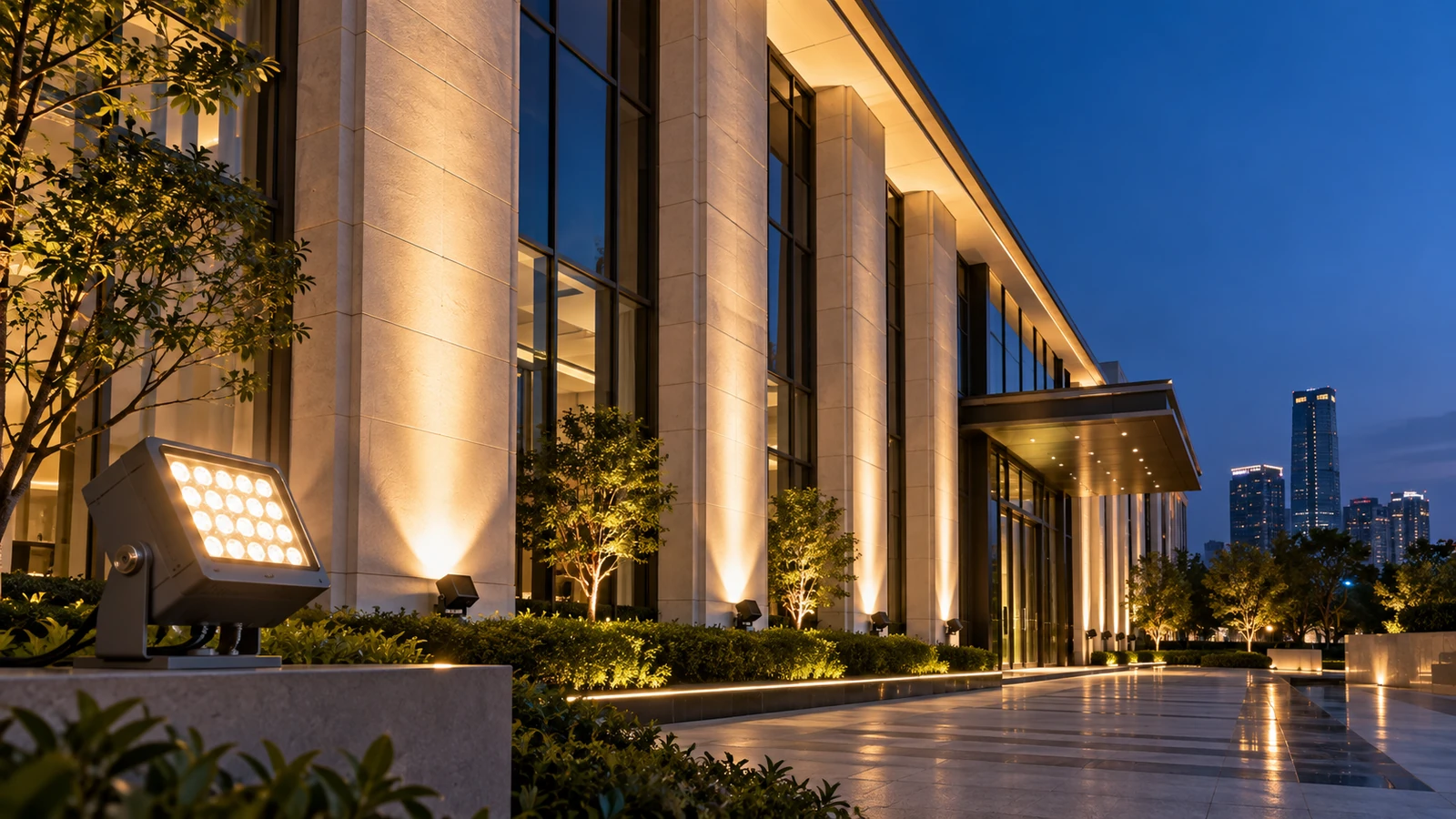
Selecting an LED floodlight for an architectural facade is not simply a matter of choosing higher wattage.
A suitable fixture should be selected according to the mounting position, throw distance, illuminated surface, required beam distribution, glare conditions, environmental exposure and control strategy.
For contractors, lighting designers and project owners, these factors determine whether the finished facade looks uniform and controlled—or suffers from hot spots, dark zones, excessive glare and difficult maintenance.
1. Start With the Surface You Need to Illuminate
Before selecting a floodlight, define the architectural target.
Ask:
- What part of the building needs to be illuminated?
- What is the mounting distance from the facade?
- How high is the target area?
- Is the surface stone, concrete, glass or metal?
- Should the light emphasize a column, wall, roof, entrance or architectural feature?
- Is uniform illumination required, or is accent lighting the objective?
The luminaire should follow the architecture rather than forcing one fixture type onto every surface.
A narrow architectural column and a broad wall normally require very different optical distributions.
2. Mounting Distance Matters More Than Wattage Alone
A common mistake is to compare floodlights only by wattage.
Two fixtures with the same power can produce very different results when their optics, mounting distance and aiming angles are different.
As the distance between the fixture and the target increases, the designer normally needs to consider:
- luminous flux;
- beam angle;
- optical efficiency;
- aiming angle;
- illuminated area;
- surrounding ambient light.
Higher wattage does not automatically mean better facade lighting.
A well-selected optical system can often produce a more useful result than simply increasing electrical power.
3. Select the Beam Angle According to the Architectural Target
Beam angle controls how concentrated or distributed the light becomes.
Narrow beams are useful when light must travel farther or emphasize a relatively narrow architectural feature.
Wider beams cover a larger surface at shorter distances but generally produce lower peak intensity.
Common architectural optics can include:
- 5°
- 10°
- 15°
- 10×30°
- 10×60°
Elliptical distributions such as 10×30° and 10×60° are particularly useful when the illuminated architectural surface is much wider in one direction than another.
The correct optic should be determined from the actual geometry rather than selected from a catalogue in isolation.
4. Check Beam Overlap and Uniformity
One fixture rarely illuminates an entire facade by itself.
Multiple floodlights therefore need to work together.
Poor spacing can create:
- bright spots;
- dark gaps;
- visible scalloping;
- excessive overlap;
- uneven vertical brightness.
During the design stage, fixture spacing and aiming should be considered together.
IES photometric files are useful for simulation before installation, especially where the project requires controlled uniformity or long throw distances.
5. Control Glare Before Increasing Output
More light is not always better light.
A powerful floodlight installed at the wrong angle may illuminate the building effectively while creating severe glare for pedestrians, drivers, hotel guests or nearby residents.
Glare control can involve:
- careful fixture positioning;
- shielding;
- louvers;
- appropriate beam angles;
- recessed or concealed mounting;
- accurate aiming.
For architectural projects, visual comfort should be considered together with facade brightness.
6. Thermal Design Directly Affects Reliability
Outdoor LED floodlights operate for long periods and often face demanding ambient temperatures.
Thermal management therefore matters as much as optical performance.
Heat must move efficiently from the LED source through the PCB and housing into the surrounding air.
Aluminium structure, thermal path design and housing geometry all affect junction temperature.
For hot climates such as the Middle East, thermal design becomes particularly important because outdoor ambient temperatures can approach 45–50°C.
Selecting a fixture only from its nominal wattage and lumen output ignores this long-term reliability issue.
7. Waterproofing Must Be Structural, Not Just a Label
Facade floodlights are continuously exposed to rain, humidity, dust and temperature cycling.
In coastal or humid environments, moisture exposure becomes even more demanding.
For outdoor architectural projects, evaluate:
- housing structure;
- glass sealing;
- cable entry;
- waterproof connectors;
- gasket design;
- pressure changes caused by temperature cycling.
An IP rating is important, but the construction behind that rating is equally important.
For difficult outdoor environments, reliable structural waterproofing reduces the risk of water ingress after installation.
8. Consider the Control Strategy Before Ordering
The control requirement affects fixture configuration.
A project may require:
- static single color;
- RGB;
- RGBW;
- DMX512 control.
For dynamic architectural lighting, the fixture and control system should be coordinated before procurement.
DMX addressing, cable topology, controller capacity, power distribution and commissioning access should all be considered during the design stage.
Changing the control architecture after installation can create unnecessary rework.
Practical Floodlight Selection Checklist
| Item | Engineering Question |
|---|---|
| Target surface | What architectural element is being illuminated? |
| Mounting distance | How far is the fixture from the target? |
| Beam angle | Narrow, wide or asymmetric distribution? |
| Output | Is the luminous output appropriate for the distance? |
| Glare | Can pedestrians or occupants see the source directly? |
| Thermal design | Can the fixture operate reliably in the local climate? |
| Waterproofing | Is the structure suitable for long-term outdoor exposure? |
| Control | Static, RGB, RGBW or DMX512? |
| Installation | Can the fixture be aimed and maintained easily? |
| Simulation | Is an IES calculation required before installation? |
Common Mistakes
The most common floodlight selection mistakes include choosing fixtures only by wattage, using one beam angle across an entire building, ignoring glare, and considering the DMX system only after installation.
Another frequent mistake is treating waterproofing as a specification-sheet item rather than examining the complete housing, connector and installation system.
FAQ
What beam angle is best for facade floodlighting?
There is no single best beam angle. Narrow beams are generally suited to longer throws or narrow architectural features, while wider or asymmetric optics are useful for larger surfaces. The final choice should follow the mounting distance and target geometry.
Is a higher-wattage floodlight always brighter on the building?
Not necessarily. Optical efficiency, beam angle, aiming and distance determine how much useful light reaches the facade.
Why is thermal management important in outdoor floodlights?
High LED and driver temperatures accelerate degradation. This becomes especially important in hot outdoor environments where ambient temperatures are already high.
Should floodlights be selected before the control system?
For dynamic projects, they should be coordinated together. Fixture type, DMX addressing, power distribution and controller architecture affect one another.
Conclusion
Successful facade floodlighting comes from matching the luminaire to the architecture.
Instead of beginning with wattage, begin with the surface, mounting distance, optical requirement, glare condition, environment and control strategy.
That approach produces a lighting system that is easier to install, commission and maintain—and more likely to deliver the intended architectural result.
CTA
Planning an architectural facade lighting project? GDXC can support fixture selection, optical configuration, DMX512 coordination and project-specific lighting solutions.