
How Beam Angle Affects Architectural Facade Lighting Results
Beam angle determines where the light goes, how far it travels and how multiple fixtures overlap. This guide explains how to choose optics for architectural facade lighting.
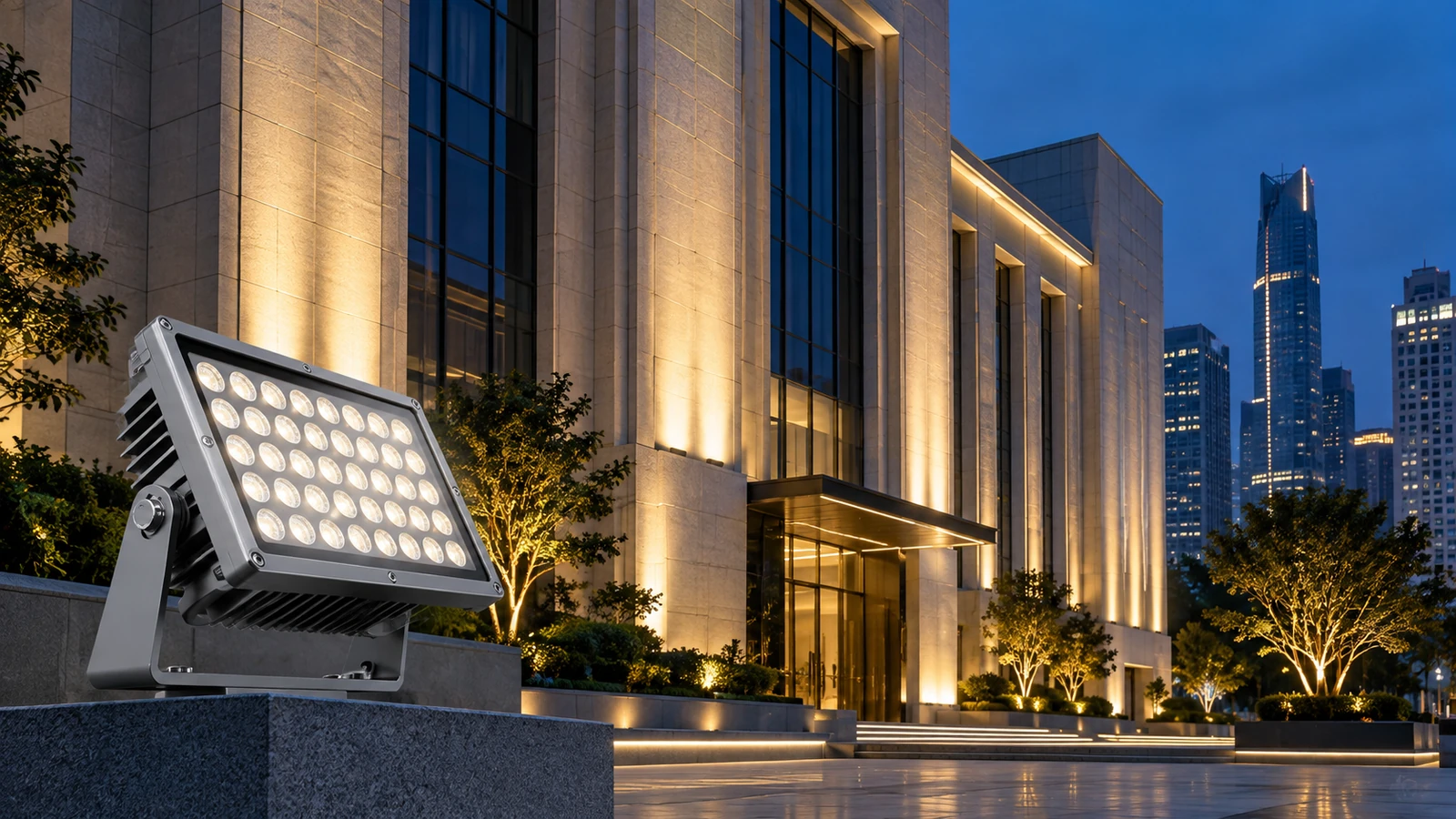
Beam angle determines how concentrated or distributed the light from a fixture becomes.
In architectural facade lighting, it directly influences throw distance, illuminated area, fixture spacing, beam overlap, visual uniformity and glare.
This means two luminaires with the same wattage and lumen output can create completely different effects simply because their optics are different.
Narrow Beam vs Wide Beam
A narrow beam concentrates more light into a smaller area.
It is commonly useful for:
- taller architectural elements;
- longer throw distances;
- columns;
- narrow vertical features;
- accent lighting.
A wider beam distributes light over a larger area.
It is commonly useful for:
- broad walls;
- short mounting distances;
- general facade illumination;
- situations where multiple beams need smooth overlap.
Neither is automatically better.
The correct beam depends on the relationship between fixture position and architectural target.
Understanding Common Architectural Beam Angles
GDXC architectural lighting applications commonly work with optics such as:
| Beam | Typical Use |
|---|---|
| 5° | Very narrow accent or longer throw |
| 10° | Narrow architectural features |
| 15° | Controlled medium-narrow distribution |
| 10×30° | Elongated architectural surfaces |
| 10×60° | Wider linear or wall coverage |
These values should be treated as optical tools rather than fixed rules.
The actual result also depends on mounting distance, fixture output, aiming angle and surface reflectance.
Why Mounting Distance Changes the Result
Imagine the same beam projected from two different distances.
At a short distance, the illuminated area is relatively small.
As the fixture moves farther from the wall, the beam footprint becomes larger.
This is why beam angle cannot be selected without knowing installation geometry.
A narrow beam at a short distance may create a concentrated hot spot.
The same optic at a greater distance may produce exactly the controlled accent the designer wants.
Beam Overlap Determines Uniformity
For continuous facade illumination, several fixtures normally overlap.
If spacing is too wide, dark gaps appear.
If spacing is too tight, the overlap areas can become noticeably brighter.
Good wall washing therefore depends on coordinating:
beam angle + fixture spacing + setback distance + aiming angle.
The goal is not simply to make each individual beam look good—it is to make the complete facade read as one coherent lighting composition.
Symmetric vs Asymmetric Optics
Circular beams such as 5°, 10° or 15° distribute light similarly in multiple directions.
Architectural surfaces, however, are often elongated.
That is where asymmetric distributions such as 10×30° or 10×60° become useful.
They allow the light to spread farther in one direction while remaining controlled in the other.
This can reduce unnecessary spill and help match the beam to the shape of the architecture.
Beam Angle and Glare
Very narrow optics can produce high intensity.
If the fixture is visible from normal viewing positions, this can increase visual discomfort.
Wider beams can also create glare when they spill beyond the intended surface.
Glare control therefore requires more than choosing a beam angle.
Consider:
- fixture location;
- shielding;
- aiming direction;
- observer position;
- mounting height;
- surrounding environment.
Wall Washers Need the Same Optical Discipline
Linear wall washers are often assumed to automatically produce uniform light.
They do not.
Uniformity still depends on:
- distance from the wall;
- spacing between fixtures;
- optical distribution;
- aiming;
- facade texture;
- installation consistency.
For example, a narrow optic may emphasize vertical height, while a wider asymmetric optic may provide broader horizontal coverage.
Use Photometric Simulation Before Installation
For projects with demanding uniformity or long throws, photometric simulation should be completed before final fixture quantities are fixed.
IES files allow the designer to evaluate:
- beam footprint;
- illuminance distribution;
- overlap;
- potential dark zones;
- approximate aiming.
Simulation cannot replace final onsite focusing, but it can greatly reduce trial-and-error during installation.
Beam Angle Selection Checklist
Before selecting an optic, confirm:
- mounting height;
- setback distance;
- target width;
- target height;
- fixture spacing;
- required uniformity;
- viewing direction;
- glare risk;
- surface material;
- whether photometric simulation is required.
Common Mistakes
One of the most common mistakes is specifying the same beam angle across an entire facade.
Buildings rarely have only one type of surface.
Columns, broad walls, roof features, entrances and landscape elements may each need different optical treatment.
Another mistake is selecting optics from a catalogue before confirming actual installation distances.
FAQ
Does a narrower beam always throw farther?
A narrow beam concentrates light more strongly, which can make it useful for longer throws, but the actual result also depends on fixture output and optical efficiency.
What is an asymmetric beam?
An asymmetric beam spreads light differently along two axes. A 10×60° optic, for example, is narrow in one direction and much wider in the other.
Which beam angle is best for wall washing?
There is no universal angle. The correct distribution depends on wall height, setback, spacing and desired uniformity.
Can I determine beam angle from wattage?
No. Wattage describes electrical power, not optical distribution.
Conclusion
Beam angle is one of the most important tools in architectural lighting design.
The correct question is not:
“Which beam angle is best?”
It is:
“Which beam distribution best matches this mounting position and architectural surface?”
When optics, spacing and mounting geometry are coordinated, facade lighting becomes more uniform, controlled and visually intentional.
CTA
GDXC supports architectural lighting projects with multiple optical distributions, IES data and project-specific fixture selection.